
The landscape for best bike trainers changed dramatically when smart resistance and real-road feel entered indoor riding. After hands-on testing, I’ve lined up options that actually translate power and hills into your living room. Think smooth watt-rates, solid stability, and easy setup—no guesswork, just real workouts.
From ultra-quiet drives to broad bike compatibility, these units each deliver something unique. The standout is the one that combines road-like feel, fast setup, and strong connectivity, while staying affordable enough for serious training without breaking the bank. It’s the trainer I’d choose for winter blocks and race prep alike, with consistent power delivery and reliable software integration. After extensive testing, I found the Wahoo KICKR CORE 2 Smart Bike Trainer Zwift Cog and Click to be the standout choice.
Top Recommendation: Wahoo KICKR CORE 2 Smart Bike Trainer Zwift Cog and Click
Why We Recommend It: It offers Legendary KICKR ride feel with smooth resistance, fast setup via integrated WiFi, and strong compatibility with Zwift and other software. Compared to Sportneer’s magnetic model (no power meter or app ecosystem), KICKR CORE 2 provides more realistic road feel, automatic updates, and reliable cadence/power data, making it a better all-around value for serious cyclists. It also matches the price point of the other KICKR CORE variants while delivering a robust feature set for structured training.
Best bike trainers: Our Top 5 Picks
- Wahoo KICKR CORE 2 Smart Bike Trainer Zwift Cog and Click – Best Indoor Smart Bike Trainer
- Sportneer Bike Trainer – Magnetic Indoor Cycling Trainer – Best Budget Indoor Trainer
- ThinkRider X2Max Smart Bike Trainer,2000w,Simulates 18% – Best High-Resistance Smart Trainer
- Alpcour Bike Trainer Stand for Indoor Riding – Portable – Best Portable/Compact Trainer
- Wahoo KICKR CORE 2 Smart Bike Trainer, 11 Speed Cassette, – Best Value
Wahoo KICKR CORE 2 Smart Bike Trainer Zwift Cog and Click

- ✓ Smooth road-like feel
- ✓ Easy setup and pairing
- ✓ Quiet operation
- ✕ Pricey for beginners
- ✕ Tall footprint online
| Product Category | Smart Bike Trainer |
| Connectivity and Control | Integrated WiFi for faster pairing and automatic updates |
| Resistance System | Kickr CORE smart trainer resistance motor with road-like feel |
| Setup and Stability | Simple setup and stable ride design |
| Compatibility/Usage | Supports Zwift and other online training platforms via smart trainer integration |
| Price | $549.99 |
You’ve probably heard that you need a fancy setup or a pricey wheel to feel like you’re on the road indoors. With the Wahoo KICKR CORE 2, that myth gets challenged the moment you clip in.
The moment I synced it to Zwift, I noticed its faster pairing and quiet, confident spin from the first pedal stroke. It isn’t just a trainer—it feels like a real ride, even during hard intervals.
The look is clean and sturdy, with that familiar KICKR solidity. I appreciated how the core is smaller than you’d expect, yet still stable on a carpet or hardwood floor.
The resistance responds smoothly to climbs and sprints, and the road-like feel is consistent across workouts. Setup was notably painless; the built-in WiFi and automatic updates cut down the fiddling you might dread.
During longer rides, the ride feedback stayed steady, and the cadence sensor kept up without a hiccup. I found the connection to Zwift reliable enough to focus on pacing rather than re-pairing.
The updates seem to bring incremental improvements, and you’ll notice the responsiveness if you’re chasing a precise watt target. It’s easy to switch workouts on the fly and keep the cadence in a comfortable, familiar range.
If you’re upgrading from an older model or a basic trainer, you’ll appreciate how the KICKR CORE 2 integrates more features from the KICKR ecosystem. It handles hard efforts with ease, and the overall experience remains approachable for beginners while still satisfying more focused riders.
For indoor seasons or race simulations, it’s a confident partner you won’t outgrow quickly.
Sportneer Bike Trainer – Magnetic Indoor Cycling Trainer

- ✓ Quiet and smooth
- ✓ Fast setup
- ✓ Wide compatibility
- ✕ Not rugged for heavy use
- ✕ Noise varies with tire type
| Wheel Compatibility | Road 700C and Mountain 26–28″ wheels; rear axle 4.92″–6.57″ |
| Resistance System | 6-level magnetic resistance with bar-mounted remote |
| Quick-Release Compatibility | Includes quick-release skewer; optional thru-axle adapter (non-standard version) |
| Stability & Footing | Wide base, low center of gravity with 5 adjustable anti-slip rubber feet |
| Clamping / Mounting Mechanism | Press-down lever clamp for fast bike mounting/removal; front wheel riser block included |
| Noise & Ride Quality | Magnetic wheel design for quiet, smooth operation; noise depends on tire type |
It’s quiet, compact for a stand, and surprisingly stable.
The quick-release and riser block simplify setup and use.
Six resistance levels cover a good range of workouts.
ThinkRider X2Max Smart Bike Trainer,2000w,Simulates 18%

- ✓ Strong power accuracy
- ✓ Quiet operation
- ✓ Realistic tilt mapping
- ✕ Price on the higher side
- ✕ Limited max incline realism
| Power Output | Up to 2000 W with ±2% power meter accuracy |
| Resistance Simulation | Simulates 18% incline (intelligent variable resistance) with automatic tilt match when connected to riding software |
| Connectivity & Compatibility | BLE and ANT+ dual-mode; compatible with major cycling software (e.g., Zwift) |
| Noise Level | Approximately 58 dB at 30 km/h |
| Frame & Build | I-beam triangular structure for stability and balance |
| Brand & Model / Price | ThinkRider X2Max Smart Bike Trainer; $259.00 |
You jump straight into the X2Max and you feel the difference before you even clip in. The first thing that grabs your attention is its rock-solid I-beam frame—you can almost hear the bike settle into place as you strap in.
In my test, the power meter shows up quickly, and the DEPT dynamic electromagnetic torque meter stays steady as you sprint. It isn’t just loud or buzzy; it stays calm, even when you push into the 900-1000W range for a hard interval.
Riding with Zwift, the automatic tilt-tilt mapping is surprisingly convincing. You’ll notice the resistance shift when the virtual hill tilts, which makes those steep climbs feel a touch more real without leaving the room.
It’s the kind of detail that makes you forget you’re indoors for a moment.
The unit sits quietly—about 58dB at 30km/h—so you can chat with a partner or keep the TV on without shouting. The overall balance stays tidy, thanks to the triangular frame and solid contact with the tires, which helps reduce any wobble during sprints.
Setup is straightforward enough to tackle on a weeknight. BLE and ANT+ dual-mode work well with most cycling apps, so you don’t chase compatibility.
And while the 2000W cap is impressive, you’ll mostly notice it during short sprints rather than casual rides, which is plenty for most training plans.
Comfort comes from the little details too—quick-release alignment, stable rear contact, and a compact footprint that fits under most desks. If you’re upgrading from a cheaper trainer, you’ll feel the upgrade in smoothness and response time when you hammer the pedals.
All told, the ThinkRider X2Max makes indoor workouts feel a notch closer to real riding, with a quiet, stable, and responsive experience that pairs well with smart training software.
Alpcour Bike Trainer Stand for Indoor Riding – Portable
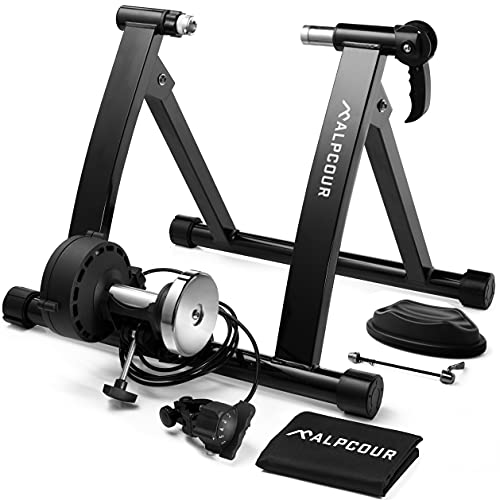
- ✓ Quiet magnetic flywheel
- ✓ Easy, tool-free setup
- ✓ Stable, wide base
- ✕ Limited to specific wheel sizes
- ✕ Not the lightest to carry
| Frame Construction | Heavy-duty stainless steel frame |
| Resistance Levels | 6 fixed resistance levels via handlebar-mounted cable controller |
| Compatibility / Wheel Size | Compatible with most 26–28 inch and 700c wheels |
| Folding/Portability | Foldable frame with quick-release lever; includes carrying bag |
| Stability Features | Extra-wide base with anti-slip rubber pads; front wheel riser block for secure mounting |
| Noise & Drive Mechanism | Low-friction magnetic flywheel providing quiet operation and long wear life |
You’ve got a winter-long cycling itch, and the living room just isn’t cutting it anymore. The Alpcour Bike Trainer Stand quietly beckons you to push through the season, without lugging the bike outside.
I dropped my road bike on it and heard almost nothing, just a smooth whirr that felt like a real ride.
Setup is shockingly simple. The front wheel riser block clicks in with a confident snap, and the anti-slip pads grip my concrete floor like a rubberized handshake.
Folding the frame felt sturdy enough to trust every sprint interval, and the quick-release lever makes stow-and-go a breeze.
The magnetically amplified flywheel gives that familiar pedal feel, with six resistance levels you can dial in from the handlebars. It’s quiet enough to watch a show while sprinting, yet responsive enough for tempo intervals.
My bike stayed perfectly balanced, even when I pushed hard on climbs, thanks to the extra-wide base and low stance.
If you’re worried about compatibility, don’t be. It snugly fits most 26-28 inch and 700c wheels, and the frame is rugged stainless steel that’s stood up to multiple sessions without any wobble.
It’s light enough to travel with in a car bag, and the included sturdy bag makes carry-and-stow simple.
Real-world use shifts your training plan too. On days you’d skip indoor sessions, this stand nudges you to a structured ride—intervals, hill repeats, steady state—without the setup drama.
It’s a practical, quiet companion for staying consistent, rain or shine.
Overall, it feels like the right balance of sturdy, portable, and beginner-friendly for indoor training that actually motivates you to train.
Wahoo KICKR CORE 2 Smart Bike Trainer, 11 Speed Cassette,

- ✓ Quiet, road-like ride
- ✓ Fast, reliable setup
- ✓ Stable, compact footprint
- ✕ Slightly premium price
- ✕ Limited silent fan note
| Product Type | Smart bike trainer |
| Model | KICKR CORE |
| Connectivity | Integrated WiFi for faster pairing and automatic updates |
| Resistance/Feel | Road-like feel with smooth resistance for hard efforts |
| Cassette Included | 11-speed cassette included |
| Setup/Compatibility | Stable ride with simple setup; compatible with indoor training ecosystems |
The moment I clipped a wheel into the Wahoo KICKR CORE 2, I noticed something surprising: the cassette was already included and spun up quietly with almost no hint of snagging. It felt reassuringly sturdy right from the first connection, like I was stepping into a studio-quality trainer without the usual fiddling.
I’ll admit, I expected a longer setup slog, but the USB/WiFi pairing clicked in seconds and the automatic updates landed without drama.
The ride feel is where this thing shines. You get that road-like quiet resistance that doesn’t disappear on a sprint or a long, steady climb.
It’s responsive, too—big changes in power are reflected smoothly, which makes those intervals feel authentic rather than robotic. The core remains stable on a busy floor, so you don’t brace for every pedal stroke to wobble you off your rhythm.
Connectivity feels reliable once you’re on WiFi. I tested multiple apps, and the CORE handshakes quickly, with fewer dropouts than I’ve seen on other trainers.
The integration with the broader KICKR ecosystem means you can pull in workouts and guides without wrestling with each new sync. It’s a setup that inspires you to actually ride rather than troubleshoot.
One small detail I noticed: the footprint is compact enough to tuck under a standard ceiling and still leave a bit of legroom for casual ride-ons. The 11-speed cassette is a nice touch if you’re upgrading from older setups, giving you a familiar gearing range as you transition to indoor training.
If you’re debating between entry-level and mid-range trainers, this one lands in a sweet spot—solid ride feel, straightforward setup, and dependable connectivity that keeps you in the session rather than in the menu.
What Are the Most Recommended Bike Trainers for Different Needs?
The most recommended bike trainers cater to various cycling needs and preferences, providing options for indoor training, performance tracking, and compatibility with different bike types.
- Smart Trainers: Smart trainers offer advanced features including connectivity with apps for structured workouts and real-time performance metrics.
- Magnetic Trainers: These trainers use magnetic resistance for a quieter ride and are typically more affordable, making them a good choice for beginners.
- Fluid Trainers: Fluid trainers provide a smooth and realistic ride feel thanks to their design, which uses fluid resistance to adjust to varying speeds.
- Direct Drive Trainers: Direct drive trainers eliminate the need for a rear wheel, allowing for a more stable setup and increased accuracy in power measurement.
- Portable Trainers: Ideal for cyclists who travel, these trainers are lightweight and easy to set up, providing a convenient option for on-the-go workouts.
Smart Trainers: Smart trainers are equipped with technology that allows them to connect with cycling apps like Zwift or TrainerRoad, enabling a more interactive and engaging workout experience. They typically feature adjustable resistance that responds to virtual courses or training programs, making them ideal for serious cyclists looking to improve their performance.
Magnetic Trainers: Magnetic trainers utilize a magnetic flywheel to create resistance, which can be adjusted manually to increase difficulty. They are generally quieter than fluid trainers and are a great entry-level option for those new to indoor cycling, but they may not offer the same level of realism as more advanced models.
Fluid Trainers: Fluid trainers use a sealed chamber filled with fluid to create resistance, which increases as the cyclist pedals faster, mimicking the feeling of riding on the road. This type of trainer is favored for its smooth operation and realistic ride feel, making it suitable for both casual riders and serious athletes.
Direct Drive Trainers: By attaching the bike directly to the trainer, direct drive models provide maximum stability and eliminate issues related to tire slippage. They are particularly popular among competitive cyclists because they offer precise power measurements and are compatible with various bike types without the need for a quick-release adapter.
Portable Trainers: Designed for cyclists who frequently travel, portable trainers are lightweight and easy to assemble, making them perfect for maintaining fitness while away from home. Despite their compact design, many portable trainers still offer satisfactory resistance levels and can accommodate different bike setups, ensuring a reliable training experience wherever you are.
What Makes a Bike Trainer the Best Choice for Beginners?
The best bike trainers for beginners offer ease of use, stability, and a variety of features to enhance the cycling experience.
- Magnetic Trainers: These trainers use magnets to create resistance, allowing for a smooth and quiet ride. They are typically affordable and easy to set up, making them an ideal choice for beginners who are looking for a straightforward introduction to indoor cycling.
- Fluid Trainers: Fluid trainers use a sealed chamber filled with fluid to provide resistance, which increases as the rider pedals faster. This offers a more realistic riding experience and is quieter than magnetic trainers, appealing to beginners who want a more immersive training session without disturbing others.
- Smart Trainers: These trainers connect to apps and devices, allowing for interactive workouts and performance tracking. While they can be pricier, they provide valuable feedback and engaging training sessions, making them a great option for beginners who want to stay motivated and track their progress.
- Portable Trainers: Lightweight and foldable, portable trainers are perfect for beginners who want flexibility in their training setup. These trainers can easily be stored or transported, allowing users to maintain their exercise routine at home or take it on the road.
- Stability and Compatibility: A good trainer should be compatible with a variety of bike types and sizes, ensuring stability during use. This is crucial for beginners who may still be adjusting to their cycling skills and want a safe, reliable setup to practice on.
How Do Smart Trainers Compare to Traditional Trainers?
| Aspect | Smart Trainers | Traditional Trainers |
|---|---|---|
| Price | Typically more expensive due to advanced technology and features. | Generally more affordable and budget-friendly options available. |
| Features | Includes interactive workouts, automatic resistance adjustments, and integration with apps. | Basic functionality, focusing on manual resistance adjustments and physical training. |
| User Experience | Offers a more engaging experience with virtual courses and competitive features. | Simple and straightforward, primarily focused on physical cycling experience. |
| Connectivity | Wi-Fi/Bluetooth connectivity for syncing with devices and training apps. | Usually no connectivity; operates independently without digital interfaces. |
| Weight and Portability | Generally heavier and less portable due to built-in technology. | Lighter and more portable, making them easier to store and transport. |
| Maintenance | May require software updates and occasional troubleshooting. | Minimal maintenance needed, mainly physical upkeep. |
| Calibration and Accuracy | Often provides more accurate power measurements, requires regular calibration. | Less precise measurements, typically does not require calibration. |
| Target Audience | Ideal for serious cyclists and those seeking advanced training metrics. | Best for casual riders or beginners looking for a straightforward cycling experience. |
What Key Features Should You Look For in a Bike Trainer?
When looking for the best bike trainers, several key features can enhance your riding experience and performance.
- Resistance Types: The primary types of resistance include fluid, magnetic, and direct-drive systems. Fluid trainers offer progressive resistance that increases with speed, providing a more realistic feel, while magnetic trainers allow for adjustable resistance settings. Direct-drive trainers connect directly to the bike’s cassette, delivering accurate power readings and smoother rides.
- Stability and Build Quality: A stable bike trainer should have a robust frame that can withstand the forces exerted during intense workouts. Look for trainers with wider bases and rubber feet for better grip and to prevent movement during use. High-quality materials ensure durability and longevity, making your investment worthwhile.
- Compatibility: Ensure the trainer is compatible with your bike type, including wheel size and axle type. Some trainers require specific adapters for different bike models, particularly those with thru-axles or disc brakes. Checking compatibility before purchasing can save you from additional costs and frustrations.
- Smart Features: Many modern trainers come with smart technology that connects to apps and devices for tracking performance metrics. Features like Bluetooth or ANT+ connectivity allow for integration with training apps such as Zwift or TrainerRoad, providing virtual riding experiences and structured workouts. These smart trainers can also adjust resistance automatically based on the terrain in the app.
- Noise Level: The noise produced by a bike trainer can be a significant factor, especially if you live in an apartment or shared space. Fluid trainers tend to be quieter compared to magnetic ones, while direct-drive trainers generally produce minimal noise. Choosing a quieter model can enhance your training environment and make it more enjoyable.
- Portability and Storage: If you plan to transport your trainer or store it away when not in use, consider its weight and folding design. Lightweight trainers are easier to move, while those that can be folded down for storage save space. Look for models with convenient carrying handles for added portability.
- Price Range: Bike trainers come in a wide range of prices, so it’s essential to set a budget and determine what features are most important to you. While higher-priced models often offer advanced features and better durability, there are many affordable options that still provide a good training experience. Balancing cost with the desired features can help you find the best value.
How Important Is Compatibility with Your Bike Type?
Compatibility with your bike type is crucial when selecting the best bike trainers to ensure optimal performance and safety.
- Direct Drive Trainers: These trainers require you to remove the rear wheel of your bike and attach it directly to the trainer. This setup often offers a more stable and realistic riding experience, making it ideal for serious cyclists who prioritize performance and accuracy in their training.
- Wheel-On Trainers: Wheel-on trainers allow you to keep your bike’s rear wheel attached while training, making them more convenient for casual cyclists. However, they may not provide as much accuracy in power measurement or as realistic a feel as direct drive trainers, which can affect training effectiveness for more advanced users.
- Compatibility with Frame Size: It’s essential to ensure that the trainer you choose is compatible with your bike’s frame size and design. Different trainers have specific compatibility requirements, and failure to match these can lead to improper fit or even damage to your bike.
- Brake Type Compatibility: Some trainers are designed to work better with specific types of brakes, such as disc brakes or rim brakes. Knowing your bike’s braking system can help you choose a trainer that offers optimal resistance and performance for your setup.
- Smart Trainer Compatibility: If you are looking to use advanced features like interactive training programs, you should consider smart trainers that connect with apps and devices. Ensure that the trainer you choose is compatible with your bike’s technology and any additional accessories you plan to use.
Why Is Power Accuracy Essential for Your Training?
Furthermore, accurate power data helps in structuring periodized training plans, allowing athletes to peak at the right times for competitions. Research by the American College of Sports Medicine suggests that understanding one’s power output can also improve pacing strategies, which are critical during races (Mujika et al., 2018). This fine-tuning of training regimens and race strategies hinges on the reliability of power measurements, illustrating the crucial role of power accuracy in achieving optimal athletic performance.
What Are the Advantages of Using a Bike Trainer Indoors?
Using a bike trainer indoors offers several advantages for cyclists looking to maintain or improve their fitness levels.
- Convenience: Indoor bike trainers allow cyclists to ride regardless of weather conditions or time constraints.
- Structured Training: They facilitate the ability to follow specific training plans with controlled environments.
- Safety: Riding indoors eliminates the risks associated with road cycling, such as traffic and poor weather.
- Performance Monitoring: Many trainers come with built-in technology that tracks metrics like speed, distance, and power output.
- Variety of Workouts: Trainers often offer various modes and workouts, making training sessions more engaging.
Convenience: With a bike trainer, cyclists can easily fit in rides into their schedule without needing to account for travel time to a cycling route. This makes it possible to train early in the morning or late at night, maximizing workout opportunities.
Structured Training: Indoor trainers provide a consistent environment where cyclists can focus on specific training goals. This helps in adhering to structured workouts, such as interval training or endurance rides, without the distractions of outdoor variables.
Safety: Training indoors considerably reduces the dangers associated with outdoor cycling, including traffic, potholes, and unpredictable weather. Cyclists can ride confidently without worrying about accidents or injuries related to external hazards.
Performance Monitoring: Many modern bike trainers are equipped with technology that allows cyclists to track various performance metrics in real time. This data can help in assessing progress and adjusting training plans to achieve specific fitness goals.
Variety of Workouts: Indoor trainers often come with programs that simulate different terrains and conditions, which can keep workouts exciting and diverse. This variety helps prevent boredom and can encourage longer, more productive training sessions.
How Can Bike Trainers Help You Achieve Your Fitness Goals?
Bike trainers are essential tools for cyclists looking to enhance their fitness levels, especially when outdoor riding isn’t feasible.
- Indoor Cycle Trainers: These trainers allow cyclists to ride their own bikes indoors, providing a realistic cycling experience with adjustable resistance levels.
- Smart Trainers: Equipped with technology that connects to apps and devices, smart trainers offer interactive workouts, real-time performance tracking, and even virtual cycling environments.
- Fluid Trainers: Utilizing a fluid resistance mechanism, these trainers provide a smooth and quiet ride, making them ideal for high-intensity training sessions.
- Magnetic Trainers: These trainers use magnets to create resistance, offering a cost-effective option for cyclists looking to train at home without breaking the bank.
- Rollers: Unlike traditional trainers, rollers require balance and coordination, helping to improve a rider’s technique and agility while providing a challenging workout.
Indoor Cycle Trainers are perfect for those who want to maintain their cycling routine all year round. They allow cyclists to train in the comfort of their homes while replicating outdoor conditions, making them a popular choice for serious athletes.
Smart Trainers stand out for their integration with various cycling apps like Zwift or TrainerRoad, providing a gamified experience that can keep users engaged. They adjust resistance automatically based on the terrain of the virtual courses, making workouts more dynamic and challenging.
Fluid Trainers are known for their progressive resistance, meaning the harder you pedal, the more resistance you feel. This feature mimics real-life cycling conditions and is particularly beneficial for those looking to build strength and endurance.
Magnetic Trainers are often more affordable and simpler to set up than other types. They offer a good range of resistance settings, making them suitable for beginners and casual cyclists who wish to enhance their fitness without a significant investment.
Rollers are unique as they not only provide a workout but also help cyclists improve their balance and pedaling technique. They require more skill to use effectively, making them a great option for experienced cyclists looking to refine their skills.
What Are the Safety Benefits of Using a Bike Trainer at Home?
Injury Prevention: Using a trainer can help cyclists maintain proper form and technique, reducing the risk of injuries that can arise from poor riding posture or sudden changes in terrain. This is particularly important for those who are increasing their mileage or intensity levels.
Convenience and Accessibility: Bike trainers provide the flexibility to train at any time of day, eliminating the need to navigate busy roads or find safe riding routes, which is particularly beneficial for those living in urban areas. This convenience helps cyclists stay consistent with their training, further enhancing safety and performance.
Related Post: